Futurescience, LLC.
Note: This is an article about the history of electromagnetic pulse based on material that I originally wrote for Wikipedia. The "Nuclear Electromagnetic Pulse" article in Wikipedia occasionally gets trashed; sometimes by people with good intentions, and other times as the result of vandalism. So I think it is important to keep this information here in a well-referenced and authenticated style. The last section, about the discovery of the unique aspects of high-altitude EMP, was specifically added to the version on this web site, and was never included in the Wikipedia article.
Earliest History
The fact that an electromagnetic pulse is produced by a nuclear explosion was known since the very first days of nuclear weapons testing, but the magnitude of the EMP and the significance of its effects were not realized for some time.1
During the first United States nuclear test in 1945, electronic equipment was shielded due to Enrico Fermi's expectation of an electromagnetic pulse from the detonation. The official technical history for that first nuclear test states, "We can understand the difficulty of transmitting signals during the explosion when we consider that the gamma rays from the reaction will ionize the air and other material within hundreds of yards. Fermi has calculated that the ensuing removal of the natural electrical potential gradient in the atmosphere will be equivalent to a large bolt of lightning striking that vicinity. . . . All signal lines were completely shielded, in many cases doubly shielded. In spite of this many records were lost because of spurious pickup at the time of the explosion that paralyzed the recording equipment." 4
During British nuclear testing in 1952-1953 there were instrumentation failures that were attributed to "radioflash," which was then the British term for EMP.5, 6
High-altitude nuclear tests in 1958 were the first indication in United States testing that high-altitude EMP could be more than 1000 times as intense as low-altitude EMP. The first reported instance of this unique high-altitude effect was in the 1958 Hardtack-Yucca test. The EMP results of Hardtack-Yucca were so different from the expected results that the data was apparently dismissed as an anomaly. (See the Hardtack-Yucca discussion below.)
The high altitude nuclear tests of 1962, as described below, increased awareness of EMP beyond the original small population of nuclear weapons scientists and engineers. The larger scientific community became aware of the significance of the EMP problem after a series of three articles were published about nuclear electromagnetic pulse in 1981 by William J. Broad in the weekly publication Science.1, 2, 3
Starfish Prime
On July 1962, a 1.44 megaton United States nuclear test in space, 400 kilometers (250 miles) above the mid-Pacific Ocean, called the Starfish Prime test, demonstrated to nuclear scientists that the magnitude and effects of a high altitude nuclear explosion were much larger than had been previously calculated. The detonation time was July 9, 1962 at 09:00:09 Coordinated Universal Time, (which was 8 July, Honolulu time, at nine seconds after 11 p.m.). The coordinates of the detonation were 16 degrees, 28 minutes North latitude, 169 degrees, 38 minutes West longitude.7 The actual weapon yield was very close to the design yield, which has been described by various sources at different values in the very narrow range of 1.4 to 1.45 megatons.
The Thor missile carrying the Starfish Prime warhead actually reached a maximum height of about 1100 kilometers (just over 680 miles), and the warhead was detonated on its downward trajectory when it had fallen to the programmed altitude of 400 kilometers. The nuclear warhead detonated at 13 minutes and 41 seconds after liftoff of the Thor missile from Johnston Island.9
Starfish Prime also made EMP effects known to the public by causing electrical damage in Hawaii, about 1,445 kilometers (898 miles) away from the detonation point, knocking out about 300 streetlights, setting off numerous burglar alarms and damaging a telephone company microwave link.7
Starfish Prime was the first successful test in the series of United States high-altitude nuclear tests in 1962 known as Operation Fishbowl. The subsequent Operation Fishbowl tests gathered more data on the high-altitude EMP phenomenon, especially the Bluegill Triple Prime and Kingfish test of October, 1962.8
The EMP damage of the Starfish Prime test was quickly repaired because of the ruggedness (compared to today) of the electrical and electronic infrastructure of Hawaii in 1962. Realization of the potential impacts of high-altitude nuclear EMP became more apparent to some scientists and engineers during the 1970s as more sensitive solid-state electronics began to come into widespread use.
The relatively small magnitude of the Starfish Prime EMP in Hawaii (about 5600 volts/meter) and the relatively small amount of damage done (for example, only 1 to 3 percent of streetlights extinguished)10 led some scientists to believe, in the early days of EMP research, that the problem might not be as significant as was later realized. Newer calculations7 showed that if the Starfish Prime warhead had been detonated over the northern continental United States, the magnitude of the EMP would have been much larger (22 to 30 kilovolts/meter) because of the greater strength of the Earth's magnetic field over the United States, as well as the different orientation of the Earth's magnetic field at high latitudes. These new calculations, combined with the accelerating reliance on EMP-sensitive microelectronics, heightened awareness that the EMP threat could be a very significant problem.
As late as the 1980s, some distinguished scientist published articles which cast doubt on the magnitude of the E1-EMP. Those scientists did not have access to some critical classified information that has subsequently been declassifed. This primary mistake that these scientists made was apparently a large underestimation of the coherence of the pulse. The initial electrons are knocked out of atmospheric molecules almost simultaneously over a large region. The electrons then spiral almost simultaneously around the Earth's magnetic field lines. This results in a very narrow pulse of extremely high field strength, but one that last for less than a microsecond. Each high-energy electronic emits only a very weak pulse, however a typical nuclear weapon produces about 10,000,000,000,000,000,000,000,000 ten septillion) of these high-energy electrons all spiraling around the geomagnetic field lines simultaneously.
Operation K, including Soviet Test 184
See the separate comprehensive and referenced article covering The Soviet Nuclear Tests in Space over Kazakhstan.
Non-nuclear history
The concept of the explosively pumped flux compression generator for generating a non-nuclear electromagnetic pulse was conceived as early as 1951 by Andrei Sakharov in the Soviet Union,12 but nations have usually kept their most recent work on non-nuclear EMP highly classified until the technology was old enough that similar ideas were widely conceived by physicists in other nations. There are a number of different types of non-nuclear EMP generators, but all of them have extremely limited range compared to nuclear EMP.
The Understanding of the Unique Aspects of High-Altitude EMP
Little is known about the history of how scientists in the Soviet Union came to an understanding of the unique aspects of high-altitude EMP. There are indications that the Soviet scientists, like the United States scientists, took a long time to completely understand the high-altitude EMP phenomenon. One of the first open scientific publications about nuclear EMP was by the noted Russian scientist Aleksandr S. Kompaneets in 1958. 13
Kompaneets theory was assumed to be accurate by many people who did not have access to the actual classified data until a 1964 report by Victor Gilinsky of the Rand Corporation pointed out a number of significant errors in the Kompaneets analysis.14
During the United States Starfish Prime nuclear test, the Soviet Union stationed scientific expeditionary ships in the Pacific near the Johnston Island launch point and at the southern conjugate region (at the opposite end of the geomagnetic field line from Johnston Island) near the Samoan Islands.15 In addition to general scientific data gathering, the Soviet scientists obviously gathered valuable data in preparation for their Operation K high-altitude tests that were carried out over Kazakhstan three months later.
A little-known fact about the sky in the conjugate region (the opposite end of the geomagnetic field line) is that immediately after a high-altitude nuclear detonation, there is a flash in the sky at the conjugate region (which is hundreds or thousands of miles away). This light can become a long-lasting aurora in that distant location.
In the United States, it was five years from the time that the first data on high-altitude EMP was obtained until an accurate understanding of that data was made by Los Alamos physicist Conrad Longmire. The Nobel Prize winning U.S. physicist, Hans Bethe had published a classified, but erroneous, theory of high-altitude EMP in 1957. Although Bethe's theory, which was basically an extrapolation of what was known about the EMP from a low-altitude nuclear airburst, was seriously called into question by actual 1958 data (and was conclusively proven wrong by the results the the Operation Fishbowl tests in 1962), Bethe's original 1957 paper remains classified secret/restricted data. Hans Bethe was one of the most brilliant physicists of the 20th century, but his high-altitude EMP paper was a very serious error. Bethe's theory underestimated the magnitude of high-altitude EMP by a factor more than a thousand, and caused considerable difficulties in obtaining actual high-altitude EMP waveforms in subsequent high-altitude nuclear tests.
A number of high-altitude nuclear tests were performed by the United States in 1958. None of the actual E1 waveforms (with measurement scales) from those tests have been declassified, but some important descriptions of the measurements and equipment have been released for the Yucca test of Operation Hardtack.16 Two other later 1958 high-altitude tests from Operation Hardtack, Teak and Orange would have produced a much more significant EMP since they were 3.8 megaton tests (using the W-39 warhead on Redstone missiles) at a much higher altitude than Yucca; however there were numerous problems in getting the data from Teak and Orange, and apparently EMP data for these test were not obtained except for very distant effects (but very large effects) that these larger explosions had on the Earth's magnetic field. These geomagnetic effects were many years later designated as the E3 component of nuclear EMP.
Declassified portions of the films of the Operation Hardtack high-altitude tests are available on the internet, and those films include other information about those high-altitude tests.18 Video of the actual balloon launch of the Hardtack-Yucca test begins at 3:52 on the film.
The first actual high-altitude EMP data came from the balloon-launched Hardtack-Yucca test.
According to report ADA322231 (ITR-1655):
|
The project provided a platform for a nuclear device and measurement instrumentation at a pressure altitude of 85,000 feet (16-1/2 millibars) by means of a large plastic balloon. The original plan called for a development program based on a pay load of 600 pounds and a floating altitude of approximately 90,000 feet. The actual weight was increased in small increments to a final weight of 761.5 pounds, with a corresponding decrease in altitude to 85,500 feet. The balloon system was launched from the deck of the USS Boxer (CVS-21). Prior to reaching ceiling altitude, the nuclear device was separated from the balloon a distance of 568 feet by a hydraulic load lowering device, and the measurement instrumentation was additionally deployed along a nylon line at specific intervals totaling 3,000 feet below the nuclear device. Both the load lowering device and the instrumentation deployment system were developed by the project. Because of the support nature of the project mission, this report does not contain weapon effect data. It is concluded that the large, plastic, constant volume balloon vehicle provided a stable and reliable platform for the very high altitude nuclear detonation, Shot Yucca.17 |
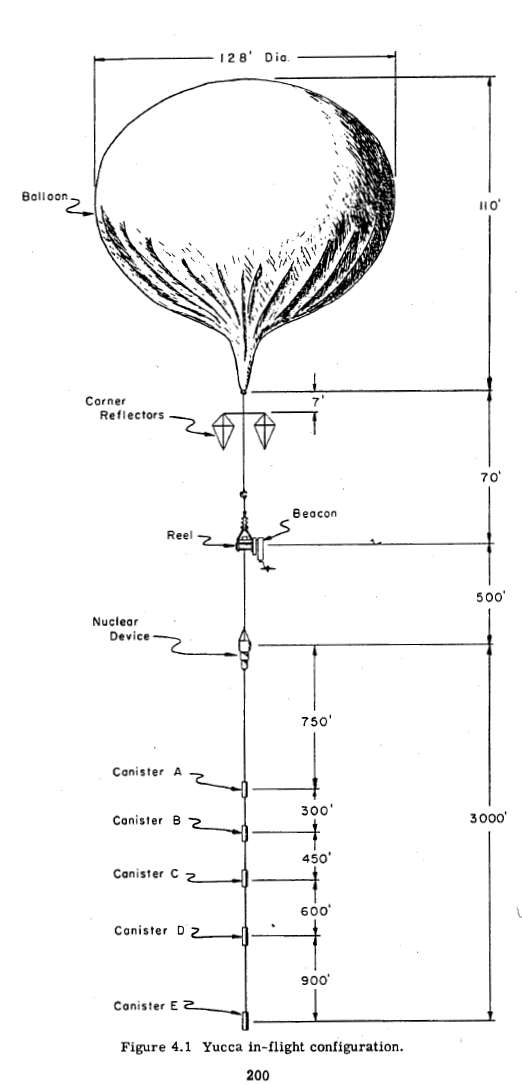
The canisters in the illustration above are instrumentation canisters. The illustration is from page 200 of the preliminary Hardtack I Report.
In order to assure that the launch of the helium balloon and the complex payload would go as smoothly as possible, the USS Boxer headed in the direction and speed of the surface winds at the time of the balloon launch so that the relative windspeed on the deck of the ship was negligible. The balloon carrying the nuclear weapon was released at 1125 local time. The balloon climbed rapidly. It reached 7,000 feet (2.1 km), in 7 minutes and 12,000 feet (3.7 km) in 15 minutes. When the balloon reached an altitude of 40,000 feet at 1206 local time, a barometric safety switch was tripped to arm the nuclear device.19
The balloon reached its target altitude of 85,000 feet (26 km.) at 1253, which was one hour and 28 minutes after launch. The balloon maintained that approximate altitude while final preparations for the nuclear detonation were made, including a delay because one of the RB-36 aircraft was out of position.
At the planned pressure altitude of 85,000 feet (26 kilometers), the 1.7 kiloton W-25 nuclear warhead was detonated at 1440 local time (mid-afternoon) on April 28, 1958.19 The operation required 3 hours and 15 minutes from its shipboard release until the nuclear detonation. The nuclear weapon weighed 218 pounds (99 kg.); and the total payload, including instrumentation, had weight of 762 pounds (346 kg.).
Attempts were made to photograph electromagnetic pulse waveforms on the islands of Wotho (northwest of Kwajalein Island) and Kusaie (one of the Caroline Islands). Successful measurements were made at Kusaie, although the waveforms shown in Figures 10.1 and 10.2 in the unclassified report have been deleted. The Operation Hardtack I report contains the following description of the measurements:
|
Shot Yucca (see Figures 10.1 and 10.2). No data was recorded at Wotho for this shot because of technical photographic problems. Several camera shutters did not open. Trace intensity was, in general, too low for proper recording. Also, field strength at Kusaie indicated that deflection at Wotho would have been some five times the scope limits. All scopes at Kusaie triggered, and the signal was recorded. The wave form was radically different from that expected. The initial pulse was positive, instead of the usual negative. The signal consisted mostly of high frequencies of the order of 4 Mc., instead of the primary lower-frequency component normally received (Figures 10.2 and 10.2). The fact that Shot Yucca was a very-high-altitude shot may have provided a more favorable propagation path for the higher frequencies that were recorded.16 |
The Yucca EMP signal was also horizontally polarized, instead of the expected vertical polarization. This means that it was more easily picked up by a horizontal antenna, rather than a vertical antenna. (In the above quotation, Mc. is the abbreviation for the now-obsolete term Megacycle, which is now called Megahertz.) The much higher-frequency components of the Yucca E1 high-altitude EMP meant that the energy was somehow being concentrated into a very fast-rising narrow pulse. Calculations have shown that the area covered by the Hardtack-Yucca EMP should have been within a radius of approximately 350 miles (565 km.) from ground zero.
Many non-scientists still argue that EMP requires multi-megaton weapons. That first indication of the dramatic effects of high-altitude EMP, however, was obtained by a weapon of only 1.7 kilotons launched by a primitive helium balloon in 1958.
Since the recorded EMP data from the Hardtack-Yucca test did not conform to the accepted EMP theory of the time, the Yucca EMP data was generally ignored until after the 1962 tests of Operation Fishbowl had shown general agreement with the Hardtack-Yucca data, and had proven the earlier theory of high-altitude EMP to have been dramatically incorrect.
For those who wish to see a short video of the actual balloon launch from the USS Boxer and the subsequent high-altitude detonation, the video is now available on this web site in Microsoft Windows Video (wmv) format. The video is just 95 seconds long and is a 3.5 megabyte download. The video is at:
You can right-click on the video link above, and then click on "save target as" or you can usually just click normally on the video link and your browser will usually give you options on what to do (depending upon the browser and other software installed on your computer). These options will usually include the option to play the video immediately if you have Windows Media Player or any other media player that will play wmv files on your computer. The video will open in a new tab or a new window. The video has a strange color tint to it because of the unfortunate dye characteristics of the 1958 Kodak film used during the 1958 nuclear test series. It wasn't discovered until more than a decade later that this film had very poor archival qualities.
More video options may become available later for viewing this video without the color distortions and with somewhat better sharpness.
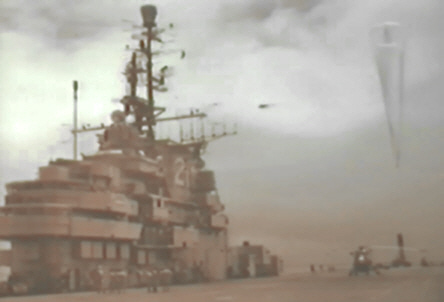 | 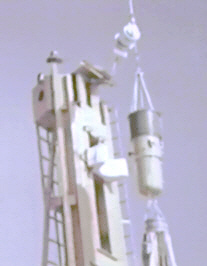 | ||
| The Yucca Balloon ready for release on the deck of the Boxer (on the right side of the photo). The photo is somewhat dark because of the fading of the red film dye over the years. | Above: The nuclear weapon assembly has just been released from the mast on the ship as the balloon begins its trip to the stratosphere. |
In 1963, U.S. physicist Conrad Longmire (1921-2010) was shown the EMP waveforms from the Operation Fishbowl Bluegill Triple Prime and Kingfish high-altitude tests. Longmire quickly deduced the actual mechanism by which the EMP was being generated.8
At first, other physicists strongly disagreed with Longmire's new theory; however, after a few days, the other high-ranking Los Alamos physicists were convinced that he was right. Presentations of Longmire's theory in subsequent months were also met, initially, with disagreement and skepticism.8 Eventually, often after doing the calculations their own way, the other physicists finally agreed with the Longmire theory. Longmire's 1963 theory of high-altitude EMP is now the basis of standard high-altitude EMP theory.
References:
1. Broad, William J. "Nuclear Pulse (I): Awakening to the Chaos Factor," Science. 29 May 1981. Vol. 212. pp. 1009-1012
2. Broad, William J. "Nuclear Pulse (II): Ensuring Delivery of the Doomsday Signal," Science. 5 June 1981. Vol. 212 pp. 1116-1120
3. Broad, William J. "Nuclear Pulse (III): Playing a Wild Card," Science. 12 June 1981. Vol. 212. pp. 1248-1251
4. Bainbridge, K.T., Trinity (Report LA-6300-H), Los Alamos Scientific Laboratory. May 1976. Page 53.
5. Baum, Carl E., From the Electromagnetic Pulse to High-Power Electromagnetics. Proceedings of the IEEE, Vol.80, No. 6, pp. 789-817. June 1992.
6. Baum, Carl E., Reminiscences of High-Power Electromagnetics, IEEE Transactions on Electromagnetic Compatibility. Vol. 49, No. 2. pp. 211-218. May 2007.
7. Vittitoe, Charles N., Did High-Altitude EMP Cause the Hawaiian Streetlight Incident?. Sandia National Laboratories. June 1989.
8. Longmire, Conrad L., "Fifty Odd Years of EMP", NBC Report, Fall/Winter, 2004. pp. 47-51. U.S. Army Nuclear and Chemical Agency.
9. Dyal, P., Air Force Weapons Laboratory. Report ADA995428. Operation Dominic. Fish Bowl Series. Debris Expansion Experiment. 10 December 1965. Page 15.
10. Rabinowitz, Mario (1987) Effect of the Fast Nuclear Electromagnetic Pulse on the Electric Power Grid Nationwide: A Different View. IEEE Transactions on Power Delivery, PWRD-2. pp. 1199-1222.
11. Longmire, Conrad L. Theoretical Notes - Note 353 - March 1985 - EMP on Honolulu from the Starfish Event. Mission Research Corporation.
12. Stephen Younger, et al. Scientific Collaborations Between Los Alamos and Arzamas-16 Using Explosive-Driven Flux Compression Generators. Los Alamos Science, No. 24, pp. 48-71, 1996.
13. Kompaneets, Aleksandr S., "Radio Emission from an Atomic Explosion". Journal of Experimental and Theoretical Physics, Vol. 35. December, 1958 (Russian-language publication)
14. Gilinsky, Victor. The Kompaneets Model for Radio Emission from a Nuclear Explosion. The Rand Corporation. August, 1964.
15. United States Central Intelligence Agency. National Intelligence Estimate. Number 11-2A-63. "The Soviet Atomic Energy Program." Page 44.
16. Defense Atomic Support Agency. ITR-1660(SAN) (Re-designated ADA369152). Operation Hardtack, Preliminary Report. 23 September 1959. (Also see the Chapter 10 pages on Yucca EMP measurements).
17. Armed Forces Special Weapons Project. Report ITR-1655 (Re-designated ADA322231). Operation of Balloon Carrier for Very-High-Altitude Nuclear Detonation. 25 July 1958.
18. Operation Hardtack High-Altitude Test Film, includes films of the Hardtack-Yucca balloon-launched 1.7 kiloton nuclear test, as well as the Redstone missile launched Hardtack-Teak and Hardtack-Orange 3.8 megaton high-altitude tests.
19. Defense Nuclear Agency. Report DNA 6038F. Operation Hardtack 1958