|
Super-EMP Weapons
for generating high-altitude E1 electromagnetic pulse
by Jerry Emanuelson
There are two possible classes of weapons that may be described as enhanced-EMP nuclear weapons. One is based on commonly known physics, and I will describe it briefly below. This first type, although never tested above ground, almost certainly exists now in the arsenals of several countries. The second type is often claimed to exist, often by very reliable sources, but virtually nothing has been made publicly known about this novel type of weapon. This makes most of what can be said about this second type mostly speculative. What is written elsewhere on this site, including what is written below about the first type of enhanced EMP weapons, is based on known physics or on de-classified documents from military services or national laboratories. We know about the first type of enhanced EMP weapons because the nuclear weapons tested before 1963, including those that caused significant EMP damage, may be considered to be suppressed-EMP weapons. If one were trying to minimize the EMP from those weapons, particularly the E1 component, they could hardly have done a better job. The E1 pulse arises from gamma rays, and from the effect of those gamma rays hitting the mid-stratosphere in the presence of a strong geomagnetic field. If you wish to minimize the E1 component: (1) Use a very thick and dense layer of chemical explosive around the nuclear material to trigger the reaction. (2) Use a very thick and dense steel casing on the entire exterior of the weapon. (3) Set off a very small fission explosion microseconds before the major (mostly fusion) thermonuclear explosion. (4) Detonate the device where the geomagnetic field is relatively weak. The numbers in parenthesis in the comments below refer to the numbered statements immediately above. In above-ground nuclear testing, they did (1) because they had to with the technology that existed then. They did (2) because they were trying to maximize the explosive power of the weapon, so they had to have a thick steel casing that would hold things together for as many milliseconds as possible. What little they knew then about EMP was mostly regarded as a nuisance. They did (3) whenever they were testing thermonuclear weapons (also known as "hydrogen bombs") because it was the only way to trigger the second (thermonuclear) stage. It didn't occur to anyone that this first fission explosion would ionize the upper half of the stratosphere, and minimize the EMP from high-altitude explosions. Even if they had known this, it is very unlikely that they would have done more single-stage testing since (at that time) they still regarded EMP as mostly a nuisance (but something possibly useful for detecting nuclear explosions in another country). For the most part, they did (4) because much of the U.S. testing was in the near-equatorial regions of the mid-Pacific. (It was a convenient location for many reasons, and especially for doing tests of very large weapons.) Actually, 3 of the first 6 high-altitude nuclear tests of the United States were done in the South Atlantic Anomaly, where the geomagnetic field is at its very lowest. Although the majority of the overall United States tests were in Nevada, they were all smaller tests and none of them were done at high altitude. Except for the those Nevada tests and the very first test (which was done in New Mexico), all of the other tests on the U.S. mainland were done underground (including a 5 megaton underground test in Alaska). Soviet high-altitude testing was done at higher latitudes, including one 40 kiloton high-altitude nuclear test (the Thunder test) in 1961 high above Stalingrad (now Volgograd) that would surely have produced a large EMP. This may be why the Soviets seemed to know about high-altitude EMP before the U.S. knew about its unusual intensity. (Soviet scientists have released details about their 1962 nuclear EMP tests, but nothing about the EMP from their earlier tests.) So the simplest way of making an enhanced-EMP weapon is simply not to do (1), (2), (3) or (4). Simply using more modern materials to avoid (1) and (2), even if the casing has to be so thin that it sacrifices some of the explosive power of the weapon, could easily increase the number of gamma rays emitted from the weapon by a factor of 10. A huge increase. To avoid (3), use only a single stage weapon, not a two-stage thermonuclear. To maximize the nuclear reaction, you probably would want to use a boosted fission method. In other words, use some of the lithium deuteride that is generally used as the "thermonuclear" part of the weapon, but use it only within the concentric shells of the single-stage weapon in order to get as much of the fissionable material to fission as possible. Alternatively, a mixture of tritium and deuterium gas under high pressure can be introduced in the hollow core of the plutonium or U-235 just before detonation. (This enables the device to be considerably miniaturized.) For the same reason, use precisely timed high-output neutron guns at the instant of detonation. With some basic physics knowledge and our current knowledge of high-altitude EMP, a weapon could easily be made that generates dramatically more gamma radiation, and that is far more efficient in turning that gamma radiation into electromagnetic pulse. In other words, any nuclear weapons state could easily create a weapon that would produce more than 25,000 volts per meter across the entire continental United States if it is detonated 250 miles (400 kilometers) above the approximate center of the continental United States. An enhanced-EMP of the type described above is basically what is used as the "primary" in a standard two-stage thermonuclear weapon. (Although these nuclear primaries are designed to maximize soft x-rays that contribute little to EMP, many of the basic design principles are exactly the same for optimizing gamma radiation, and therefore also EMP.) The nuclear primary in a thermonuclear weapon is already designed to maximize radiation output without regard to blast energy. Such a device can be designed much more simply than the devices used in 1950s designs of thermonuclear weapons; but modern computers make the exact design details of a two-point device much easier to figure out. The illustration below comes from the Wikimedia Foundation under a Creative Commons license, even though the main internal title of the diagram appears likely to be incorrect. 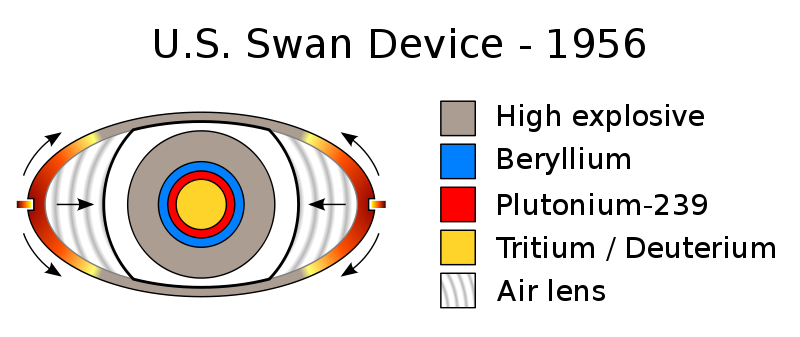 Wikipedia refers to the device above as the "Swan Device," but at least two usually reliable sources say that it is not. According to Chuck Hansen's book The Swords of Armageddon, "Gnat, Kinglet, Robin, Starling, and Tsetse were two-point primaries." (The Swan device was not.) So the above diagram is likely a representation of one of those other two-point primaries. Some well-known details are omitted from the above image to avoid excessively complicating the image. Although it is not shown in the above image, there are likely one or more neutron guns in many of these devices to increase the efficiency of the nuclear fission. Various amounts of the tritium/deuterium mix are usually added to increase (and to vary) the desired yield. (Tritium and deuterium are two isotopes of hydrogen.) The 1950s two-point primaries, like the one shown above, had weights ranging from 57 to 128 pounds, and had diameters of 11.3 to 15.3 inches, and lengths of 11.5 to 18.9 inches. Such a device could use U-235 instead of plutonium but the device would be much larger (typically about twice the diameter of the plutonium-based device), although of the same shape. Using U-235 instead of plutonium would make the device much more forgiving of small design or fabrication errors. One could also much more confidently test a device for the symmetry of the spherical implosion because ordinary depleted uranium (U-238) has virtually the same metallurgy as U-235. So depleted uranium could be use to test most of the characteristics of the detonation, but depleted uranium cannot be made to fission by using only a chemical explosive. This would avoid the finicky metallurgy of plutonium. There are many possible variations of this basic design. Some nuclear primaries were more nearly spherical. According to Chuck Hansen's The Swords of Armageddon, the Python device, which was used as a nuclear primary in the Starfish Prime warhead, had a diameter of 17.4 inches and and a length of about 26 inches. The Python device alone weighed 218 pounds and had a nuclear yield of 15 to 20 kilotons. Since the Python device was optimized to produce x-ray and gamma radiation, it would likely have produced a much greater EMP (if detonated alone outside of the Starfish Prime warhead casing) than the suppressed EMP actually produced by the Starfish Prime warhead. Rather than knocking out only 300 street lights in Honolulu, the much smaller and lighter Python device of 1962 would likely have knocked out many thousands of street lights. They already had an enhanced-EMP weapon by 1962. They just didn't know it because they weren't thinking about optimizing weapons for EMP. In addition, there are ways to generate an even larger amount of gamma rays with a two-stage thermonuclear weapon using a well-shielded primary (fission) stage and a carefully designed secondary. The design and deployment of an optimal weapon of this design is much more complicated than the single-stage weapon, but the knowledge necessary to design these more sophisicated weapons is becoming increasingly well known. One cannot keep the laws of physics a secret. Now, we will leave the realm of commonly known physics and enter an area that is somewhat speculative. There have been many claims about the existence of what are called super-EMP nuclear weapons that can generate electric fields of 200,000 volts per meter. The open scientific literature only describes the operation of first or second generation nuclear weapons which are capable of producing a maximum EMP field strength of about 50,000 volts per meter on the ground (slightly to the equatorial side of the detonation point). Maximum field strengths near the horizon would be limited to about half of this value, or 25,000 volts per meter. The reason that the maximum field strength is slightly to the equatorial side of the detonation point (in other words, south of the detonation in the northern hemisphere) is that this is where the high-energy Compton electrons start to move through the Earth's magnetic field at nearly a 90 degree angle. Obtaining field strengths that are higher than this is difficult due to saturation effects that completely ionize the mid-stratosphere where the electromagnetic pulse is generated. Basically, the process of generating the EMP in the middle of the stratosphere very quickly causes this region to become a fairly good electrical conductor, and therefore incapable of generating any additional EMP. The E1 EMP from a nuclear weapon is generated from gamma rays emitted by the weapon within the first microsecond after the nuclear detonation. One way of enhancing the EMP is simply to make sure that the weapon is constructed so that as much of the gamma radiation as possible escapes from the weapon and is radiated into the upper atmosphere in a wide area below the detonation. This can be done as described in the first section above. The (relatively) gamma-ray-transparent casing only needs to be on the lower side of the weapon. The gamma radiation that is emitted upward into outer space is wasted. The high-explosives on the earliest known nuclear weapons was quite thick, as was the very heavy outer casing. Even in the case of the 1952 super-oralloy fission weapon, which was quite sophisticated for its time, the chemical high-explosive surrounding the spherical shell of U-235 was 44 centimeters thick. When most people talk about super-EMP weapons, though, they are generally talking about nuclear weapons that can generate field strengths of much more than 50,000 volts per meter. This would require a much different design than "ordinary" nuclear weapons. Staff members of the United States EMP Commission have stated that there are nuclear weapons in existence that can generate 200,000 volts per meter below the detonation and 100,000 volts per meter near the horizon. This would have to be done by generating gamma radiation with energy levels that are far in excess of the energy levels (of about 2 million electron volts) generated by nuclear weapons described in open publications -- and by also generating a pulse of these gamma rays very rapidly. In first and second generation nuclear weapons, the prompt gamma radiation reaches its peak a few tens of nanoseconds after the nuclear detonation begins. In super-EMP weapons, it is likely that the gamma radiation would reach its peak output within a nanosecond or two of the beginning of the nuclear reaction. One consequence of this is that the frequency components in these super-EMP weapons would be much higher, making the problem of shielding and transient protection much more difficult than simply protecting against higher field strengths. The references to open literature describing super-EMP weapons outside of the United States can be found in a publication called "The Emerging EMP Threat to the United States" by Dr. Mark Schneider of National Institute for Public Policy (November 2007). It can be downloaded at: http://www.nipp.org/wp-content/uploads/2014/12/EMP-Paper-Final-November07.pdf The problem with the important references in Dr. Schneider's paper is that they are available at the Open Source Center, at http://www.opensource.gov, which is only available to employees or contractors of the U.S. federal government who have a specific need to access these documents. The referenced documents are not secret or otherwise classified documents in the normal sense, but they are nevertheless very difficult for the average citizen to obtain. Also available are a number of documents about the super-EMP weapons designed and built by the United States. The weapons produced by the United States are known as High-Power Radio Frequency (HPRF) nuclear weapons. (Adding to the confusion, though, the phrase "high-power radio frequency" weapons has also been used to describe certain kinds of non-nuclear weapons.) A number of documents about this nuclear HPRF program have actually been released; but, for obvious reasons, the bulk of the content has been deleted before the documents were released to the public. There is just enough content there to likely confirm the existence of super-EMP weapons produced by the United States, or at least a former program to produce such weapons. For example, see: http://www.futurescience.com;emp/RR00092.pdf The most worrisome aspect of these super-EMP weapons is the possibility that the construction process might be rather straightforward. Beyond the rather complex industrial capacity that it takes to produce a basic nuclear weapon, it may be that the only additional thing required to produce a super-EMP weapon is the knowledge of how to do it. If this is the case, then any country with a nuclear weapons program may be able to produce a super-EMP weapon without too much additional difficulty. Although no details about super-EMP weapons are given in open publications by anyone who knows about these weapons, there is a strong implication in the statements of those who have studied the reports about those weapons that the enhanced gamma radiation weapons would have a comparatively low total energy yield. This means that weapons with an unusually intense E1 output would not cause a large E3 output. If this is the case, then they would be very destructive to electronic devices, but would not produce the large DC-like currents that would be likely to destroy large numbers of the largest transformers in the electrical power grid. There is a possibility of a separate class of advanced super-EMP weapons that can be made using multi-stage thermonuclear techniques. In 1987, a former highly-skilled Los Alamos nuclear weapons designer wrote an article in Scientific American in which he stated that some types of thermonuclear weapons can be designed where up to 20 percent of the weapon yield would be in the form of gamma radiation. (Theodore B. Taylor, "Third-Generation Nuclear Weapons", Scientific American. April 1987. Vol. 256, No. 4. pages 30-39.) This Scientific American article implies that it is possible to make weapons that are capable of causing both a very large E1 and and a very large E3 component of the EMP.
|